The beginning
The results that closed the usual doors
Her SPM results were not good enough to open the doors most people walk through, and work was hard to find without them.
Her mother worked in saree textiles. The trade was slow, and slow trade is felt at home before it is felt anywhere else.
The beginning
Three years of somebody else's work
To help the family she took part-time work across the causeway in Singapore, and did it for three years.
What she brought back was not savings or a plan. It was fatigue. Three years of work with no larger goal at the end of it taught her something more useful than the wage did: that she needed something of her own.
Three years of work, and the only thing it built up was tiredness.
The decision
Tailoring, baking, or makeup
There were three realistic options in front of her: tailoring, baking or makeup.
She had always had a feeling for dressing well. That was the whole of it: not a business plan, just the one thing among the three she actually cared about. It was enough to decide on, and it turned out to be enough to build on.
The decision
Learning it properly, from Madam Danaletchumi
She enrolled in a makeup and bridal class taught by Madam Danaletchumi, a Singaporean woman, and found in her mentor a version of the working life she wanted for herself.
Deciding to follow in her teacher's footsteps is where the career actually begins. Everything after this is that decision, repeated daily.
Starting the business
A corner of her mother's saree shop
She started around 1996, working out of her mother's textile shop, Danaletchumi Saree Centre in Kota Tinggi. No premises of her own, no signage, no staff, just a trade practised in a corner of somebody else's business.
The first person she ever threaded was charged very little. That was not a marketing decision; it was what a beginner could reasonably ask for.
Growth
Word of mouth did the selling
People noticed that the quality was better than the price suggested, and they told other people. That is the entire growth strategy of the first decade: recommendations, from people who had taken a chance on her.
Every order that came in made the next one easier to believe in. Confidence and income grew together, each pulling the other along.
Makeup alone was never going to be enough. It is an expensive trade and a crowded one, so she trained further, taking facial, bridal and full cosmetics courses. The feedback told her she had chosen correctly.
Word of mouth spread through town faster than any sign above a door could have.
The saree years
A record Ponggal at the saree centre
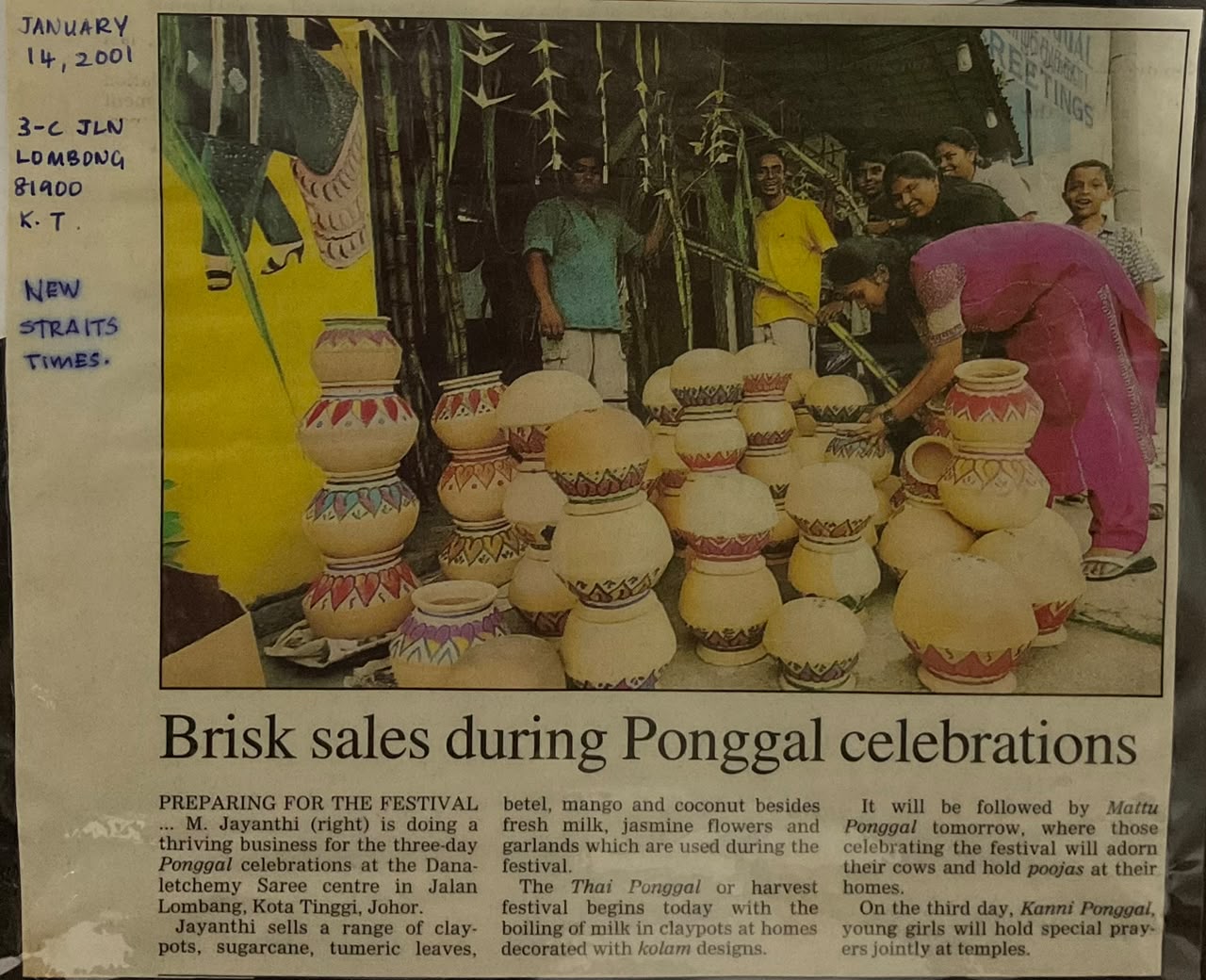
New Straits Times, 14 January 2001. Ponggal pots outside the saree centre on Jalan Lombong, Kota Tinggi. Her mother's shop was one of the first saree shops in Johor, and in the early 2000s it was doing well. In January 2001 the New Straits Times photographed it in its best Ponggal season yet: a record run of sales, with painted clay pots stacked outside the door.
Ponggal is the Tamil harvest festival. Families boil rice with milk and sugar in a new clay pot until it overflows, and that sweet rice, also called ponggal, is offered in thanks to the farmers and to the harvest that puts rice on every table.
The pot is meant to boil over. That is the whole point: more than enough.
The saree years
Early with what people wanted to wear
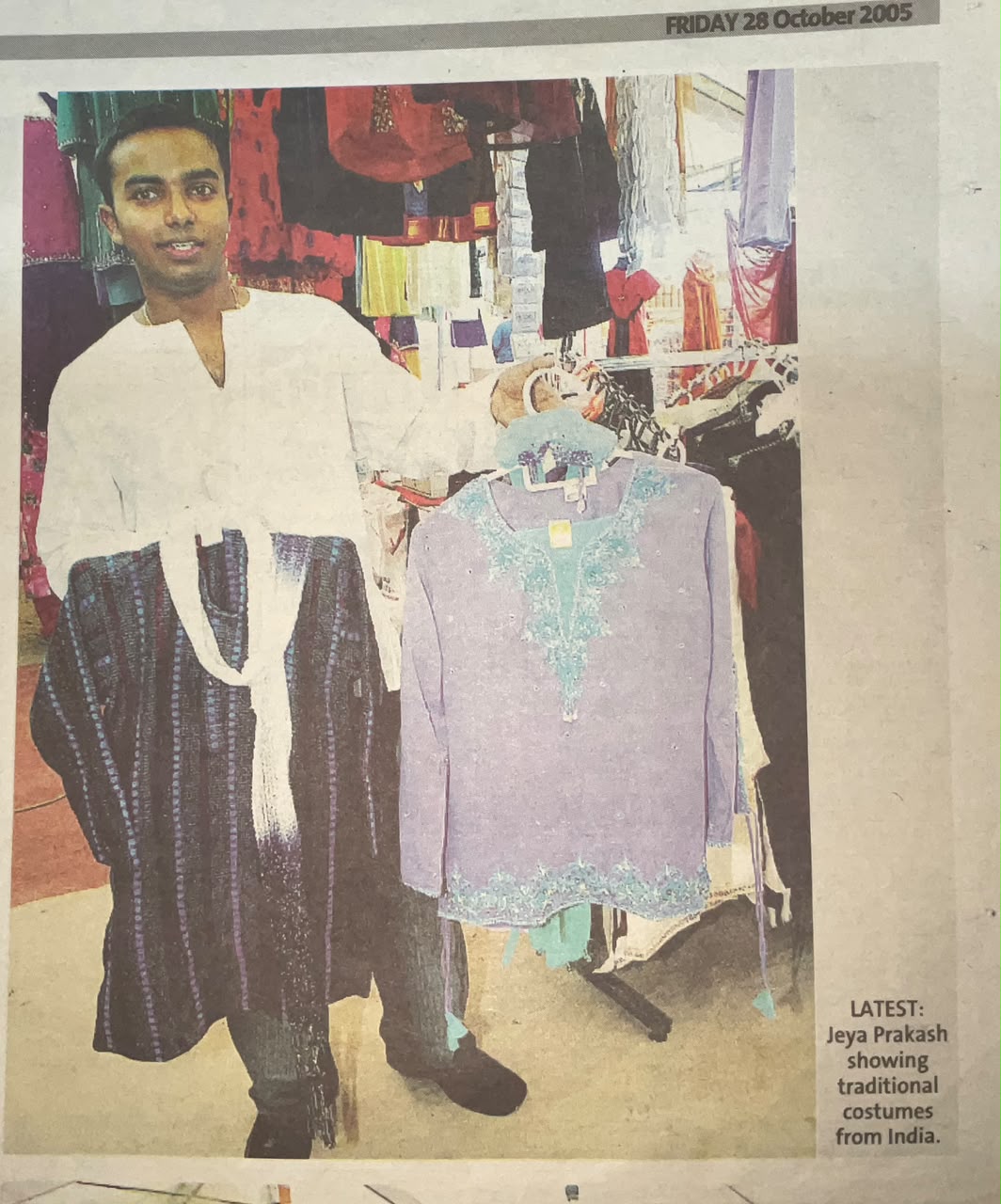
October 2005. Mr Jeya Prakash showing the traditional wear from India that was in fashion that season. The shop never stood still. By 2005 it was bringing in traditional wear from India while it was still new, and the papers came back: Mr Jeya Prakash, photographed that October, holding up the shirts everyone was asking for that season.
Being early was the shop's habit, from the first sarees it brought to Johor to the newest cuts of the year.
The setback
The water took all of it
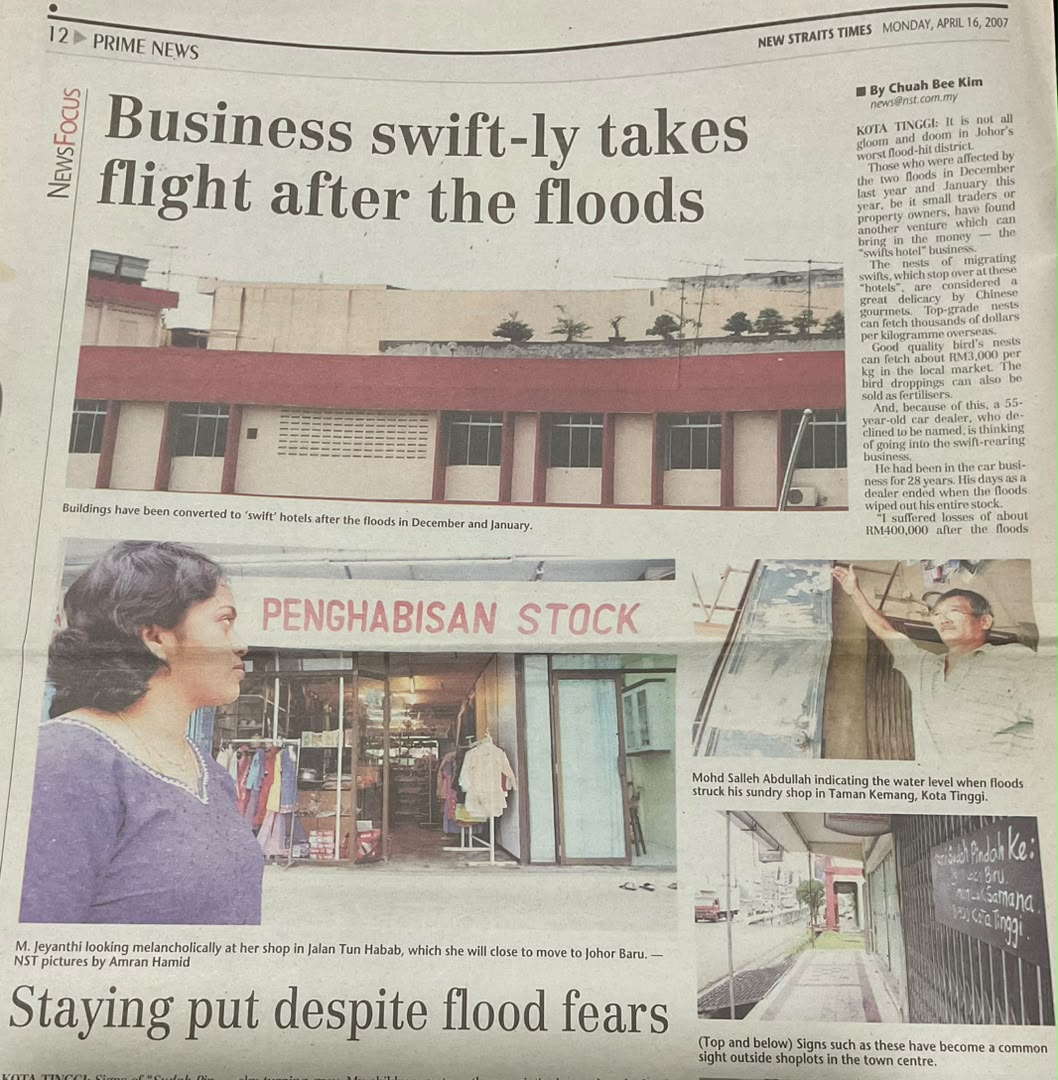
New Straits Times, 16 April 2007. Outside her shop on Jalan Tun Habab, Kota Tinggi, in its last days before the move to Johor Bahru. Then came the Great Flood of 2006-2007. Kota Tinggi went under twice, in December and again in January.
The business was destroyed and the products were ruined. She came back to broken walls and shattered mirrors, and for a time it broke her will. The saree trade, after all its good years, never got its momentum back.
In April 2007 the New Straits Times found her outside her shop on Jalan Tun Habab, a clearance sign over the door. It was the first time she had ever had to close a shop, and she was closing it to start again in Johor Bahru.
Broken walls and shattered mirrors. She had built it once, so she knew it could be built twice.
What carried over
What the saree shop left her
Sarees are not the business any more. What carried over from her mother's shop is the knowledge: years among sarees of every kind, and of learning how each one is woven and what it is made of.
That is why she does not drape every saree the same way. A heavy silk, a soft cotton and a light georgette fall differently, so the pleats, the tuck and the pallu are worked to suit the saree in front of her.
Saree draping is the one service on the menu that came to her from her mother.
Present day
A studio in Taman Daya
Today the work happens in a small studio in Taman Daya, Johor Bahru, with one treatment room, one hall, and a service list that runs from a single brow thread to a course of Sothys hydrating intensives.
She still does not watch her competitors. Her position is that the market sorts itself out and the only signal worth reading is what the person in the chair tells you afterwards.
It is deliberately small. Growing it would mean hiring hands she has not trained herself, and that is the one compromise she has never been willing to make.
Our story
Three decades, one flood, and a trade she built twice.
It started around 1996, in a corner of her mother's saree shop, with one customer charged almost nothing. Everything since has been built on what that customer told other people.
The beginning
The results that closed the usual doors
Her SPM results were not good enough to open the doors most people walk through, and work was hard to find without them.
Her mother worked in saree textiles. The trade was slow, and slow trade is felt at home before it is felt anywhere else.
The room, most evenings, after the last appointment.
The woman behind it
What she is actually trying to do
Ask her what problem she solves and she does not talk about skin. She talks about how someone feels walking out, mentally as much as physically. The massage is not the part of the facial she is willing to shorten, because it is the part that does that work.
What she is proudest of is not a treatment. It is the moment a customer who has carried pain in her shoulders for years stands up and notices it has gone. Almost all of the feedback across her career has been good, and that feedback is the thing that has kept her going through the parts that were not.
She does not watch her competitors. Her view is that if you pay attention to the person in front of you, the market takes care of itself.
Nearly everyone who sits in her chair is a woman: mothers, women running their own small businesses, women from every background this city has. She keeps up with them outside the shop too. That is not a business practice; it is just how she works.
What she wants next
To see at least ten women running businesses of their own, dependent on nobody. More branches, but only carefully, because a branch is only ever as good as the structure underneath it and the people running it.
Every face that leaves this room was worked on by the person who owns it.
The rest is just the treatments themselves.
If the story is why you came, the menu is where to go next.